Beginning in early September, Richard spent five weeks walking the Camino de Santiago, a 780 km pilgrimage from St Jean Pied de Port in Southern France, over the Pyrenees Mountain range and across Northern Spain to the Cathedral in the city of Santiago de Compostela…
The essence of pilgrimage is both journey and destination, each being significant in their own right. With 780 km of Spanish countryside, towns and villages lying before me, it would have been easy to fall into the trap of goal-orientated daily walks leading towards a pre-defined arrival date in the city of Santiago de Compostela. Yet, in the early days of my Camino de Santiago Father clearly spoke saying, “Richard, you’ve already arrived…”
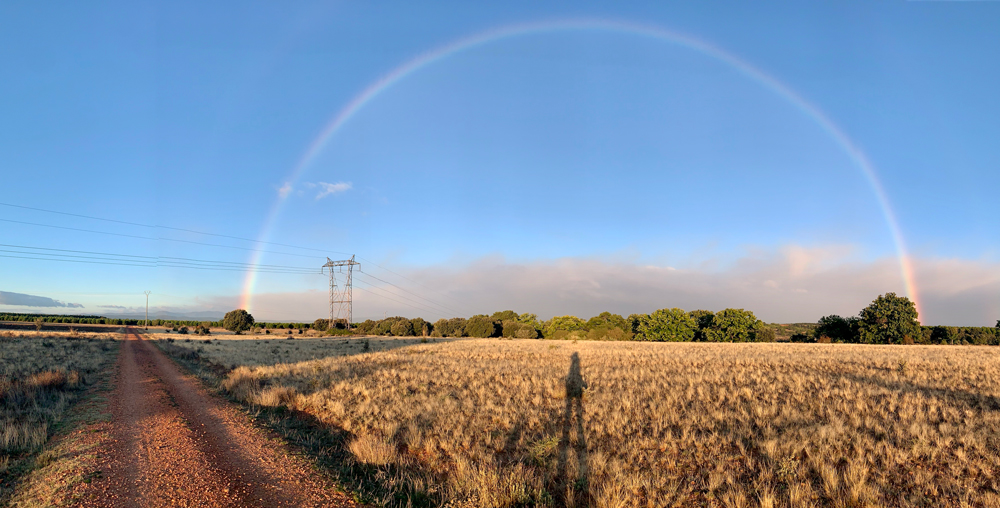
In the first few days I was distracted by the unfamiliarity of my experience; wondering how far I could walk each day, where and what I would eat, finding places to stay at night, meeting fellow pilgrims, and the general buzz of finally walking ‘my Camino.’ But with Santiago still hundreds of kilometres beyond the horizon, it wasn’t long before I settled into a daily rhythm, previous distractions and the noise of my ‘normal life’ increasingly faded into the background, and I began to fully enjoy each day for its unique once-in-a-lifetime experiences. Gradually it became far less about the destination and much more about the present moment; savouring each expression, each new vista, each rich conversation or energy-inducing KitKat sandwich. There was no hurry… after all I’d already arrived.
‘Living in the present moment’ has become a popular cliché, yet ultimately it is not something defined by external environment, it flows instead from the interior stillness of a heart quietened and satisfied by Love. If it were about external environment, then of course it’s easy to live in the moment when enjoying a bowl of juicy red strawberries, swimming delicately in a pool of thick dairy cream and gently frosted with a layer of icing sugar – see, you’re there already! If ‘Living Present’ is about external environment, then it’s not so easy to dwell there when with each step you take the red-raw blisters inside your hiking boots are screaming bloody murder and you’ve still got a further 20 km to walk before you can take those boots off! In that moment you are fully invested in living somewhere else, in every form of distraction therapy until you walk through the pain. ‘Living present’ is a manifestation of interior stillness, of contentment, of living Loved – it is to dwell beyond the external.
On the journey it’s easy to be distracted by our pain, to judge ourselves unworthy pilgrims, constantly apologising for our inadequacies, living in the regrets of yesterday and in fear of tomorrow’s failures. Condemnation is our enemy’s primary weapon of mass-distraction, yet our Father is far more consumed with enjoying who we are right now and who we are becoming, for in Love there is no record of wrongs.[1] Forgiveness is not the major issue of Christianity, it is a magnificent doorway through which we pass along the path, a completed work. It’s good to be reminded that in the beginning, in the garden, forgiveness was completely a non-issue, it was irrelevant, and in eternity it will once again become utterly irrelevant. Why then do we spend so much time and energy here chasing our tails? It seems God’s greatest challenge is not our sin, his greatest challenge is that he’s already forgiven us and we are still too afraid to enjoy him or too busy trying to prove our worthiness. John Eagan, an American High School Teacher wrote in his journal, “God is asking me, the unworthy, to forget my unworthiness and that of my brothers, instead daring to advance in the Love that has renewed and redeemed us all in God’s image.” As such, we can journey through our pain and emerge on the other side in the place of interior stillness, with a heart quietened and satisfied by Love.
The Christian philosopher Peter Kreeft writes, “Infants sleep most because they have been sleeping since the foundation of the world and the habit is not easily broken… It is appropriate that old people sleep less than young, for they are closer to eternal wakefulness, closer to the divesting of the habit of sleep altogether.”[2] I love this picture of pilgrimage, particularly the first statement, “Infants sleep most because they have been sleeping since the foundation of the world.” From the moment we were first joyfully conceived in the heart of our Father, before the creation of the world,[3] we lay sleeping in his heart until He laid us down gently in the womb of our mother. Since that day we have been gradually waking, ultimately destined to be fully re-united with the heart from which we were originally conceived. Pilgrimage is about waking up.
“Richard, you’ve already arrived…” Pilgrimage is about waking up.
The physical world in which we live is not our home, it is a foreshadowing, we are merely passing through towards a much, much greater reality, one teeming with expectancy and all-saturating Life. At present, we see only in part, as though spying through a keyhole or gazing through the morning mist. We only see outline, we see shadow; but He is drawing us forward towards the dawn. He has placed eternity in our hearts and is waking us into His Fullness. Pilgrimage is about waking up.
[1] 1 Cor 13:5
[2] Kreeft, Peter – Love is Stronger than Death (Ignatius Press, San Francisco 1992), page 82.
[3] Ephesians 1:5
 Replenish
I walked the Camino in June-July of 2019 (SJPP to Santiago and on to Fisterra and Muxia) and was scheduled to be back to walk the Portuguese route this past June. Oh, how healing it was, and how it calls me back!
LikeLike
I can totally relate to that call to return!
LikeLike
Will you be heading back this coming year?
LikeLike
Oh how my heart longs to embark on such an adventure! An, unbecoming! Thank you dear brother for sharing your heart with us! Come visit soon, Canada (and us) miss you!
Tim and Kate 🙂
LikeLike
Always good to hear from you Kate and to adventure together. Sending much love from Nia and I x
LikeLike