“Love always leads you home!”

“Love always leads you home!” I’ll never forget hearing those words and what they meant to me.

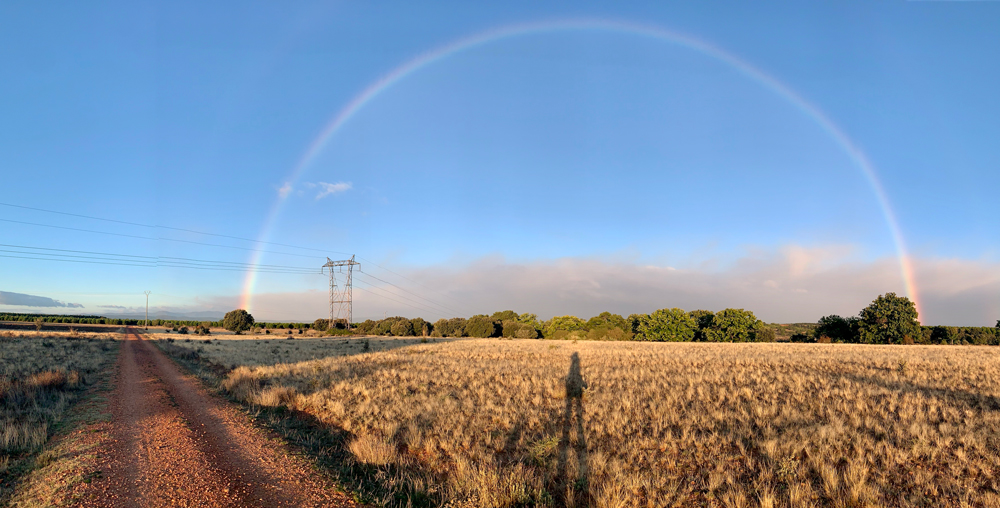
In July 2021, having walked the full Camino de Santiago in September and October the previous year, I decided I would return to Spain and walk part of the pilgrimage again. We were supposed to be in Canada at that time, but Canadian border restrictions hadn’t lifted, and with Nia’s blessing, I decided to once again stretch my legs in Spain. I remember saying to Nia prior to my departure, “I’m just going to walk until I stop having fun, then I’ll come home…”

I hadn’t accounted for how much hotter it would be in July, the heat being unbearable by eleven in the morning. I was having to get up at 5 am to avoid that midday heat. In my hurry to head to Spain I’d also made un unfortunate shoe choice. As a consequence, in the first two weeks I’d lost two toe nails. I recall waking up one morning and concluding, “I think I’m done,” but decided to wait until later in the morning to call Nia and run my decision by her. So I got up and began the day’s walk.
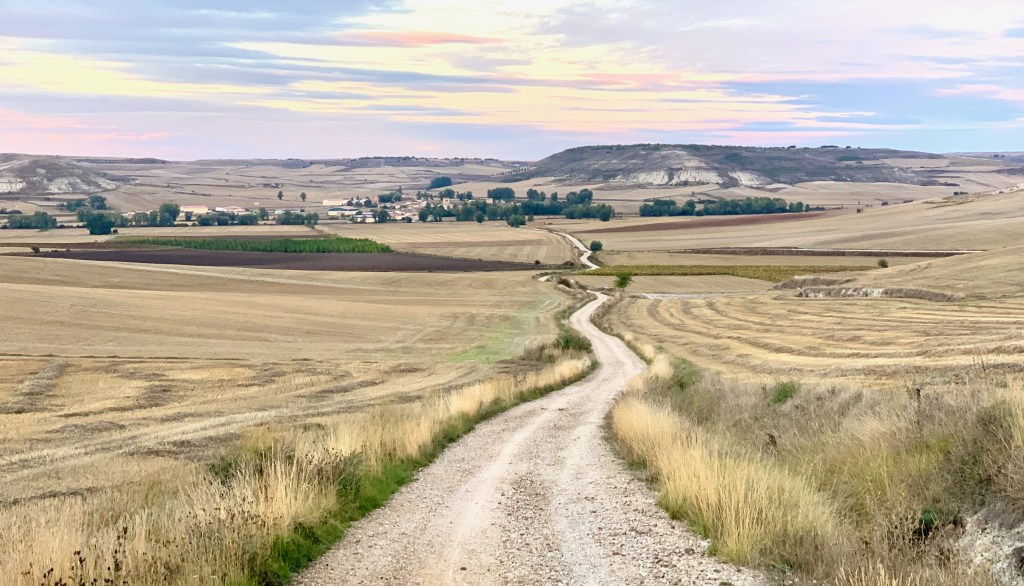
When I finally decided to call Nia, there was no cell phone signal, so I walked for another hour and finally chatted with her about 10:30 am. I described where I was at in my heart and she concurred with my decision to call it a day and head home. I remember saying to her that the return journey might take me two or three days–I was somewhere in the middle of the Spanish countryside and I would need to get to a major city with an airport, get a Covid test and, assuming the test came back negative, then book a flight home. I really had no idea where I was or where I needed to go.

As I walked on for another hour I arrived in a small village with a café. Through a translator I asked if there was a bus stop in the village and determined that there were two buses each day and that the next was in 45 minutes. Some hand singles sent me in the right direction, and having found the bus stop I sat on the ground, delivered my feet from my hiking shoes, and donned some flip-flops. In due course the bus arrived–only it was more akin to a small minibus, not quite what I had imagined. I didn’t even know where it was going but decided to board and see where it might carry me.

On-route, I determined that the end of the line was the city of Burgos. Despite being a city of some size, Burgos only has a military airport. As I explored Google Maps wondering where to go from there, Madrid seemed as close as anywhere else and it would logically be a place where Covid testing would be readily available. Literally as I was having that thought, the mini-bus pulled into Burgos central bus station and we drew up and parked next to a large bus destined for Madrid! With a little help, I secured a ticket and boarded the bus just as its engine sprang to life, the bus almost immediately pulling out of the bus station for Madrid.

Madrid was about 2+ hours away, so as I watched the Spanish countryside passing me by, I began to consider my next steps. I needed to Covid test. I called Nia to ask her to help and after a little research she called me back to say the Covid test centre at Madrid airport was fully booked for the next week! Fortunately she’d found another test centre a taxi ride away from the airport. They could do a one-hour test that evening at 6:30 pm but is was 200 euros–my flight to London might be cheaper than that! It seemed like I had no choice but to swallow the cost and Nia kindly booked me in. I then began to wonder where I should stay that night. It seemed logical to look for a place near the airport, and amazingly I found a 5-star hotel for just 30 Euros and booked.

When I’d boarded the bus to Madrid, I hadn’t had time to ask its final destination in the city. Instead I imagined it would take us to the city centre and that I could transfer there to an airport bus. As I was having this thought, we were approaching the outskirts of Madrid, and suddenly the bus pulled off the highway and headed east–you’ve guessed it, to the airport! Apparently, the bus goes to the airport first before heading into the city centre. Talk about a guided tour!

A short time later, I gathered up my belongings and descended the steps from the bus at Madrid Airport. There were four people standing on the forecourt in front of me. I inquired as to whether anyone spoke English and on receiving an affirmative nod from one, asked, “Do you know where I can get a hotel shuttle?” His response was to point to a spot on the curb about 3 metres to my right and say, “Wait just there!” Seriously? But he was right! I literally descended from the Madrid bus on the spot where I would catch the free shuttle to my hotel. 15 minutes later, I was in the hotel foyer checking in. My journey had been seamless, almost impossibly smooth.

Since it was only mid-afternoon when I got to my room, I decided to see if I could reschedule my Covid test for an earlier slot. This would allow me to start looking at flights for the next day. When I called, it became apparent that Nia had booked a 24-hour test not a 1-hour test, but no problem, I rebooked and could go straight away. My taxi driver was friendly and super helpful. He agreed to drop me off and then wait for me around the corner.

Then came the painful experience of handing over 200 euros for my 1-hour Covid PCR test. As the attendant was taking my payment she inquired as to my destination. When I responded, “London”, she stopped in her tracks and said, “You only need a Lateral Flow test then, it’s 45 Euros and you get the result in 15 minutes!” 10 minutes later I was exiting the test centre, my original payment refunded, and back in my taxi. Before I even arrived at the hotel, an email dropped into my inbox to inform me that my test had come back negative. I was all set to fly.

It was too late to secure a flight for that day, and besides I wanted to indulge in my 5-star experience! Flights were still sparce back then, but I found one for 6:30 am the next morning with Iberian, flying straight into Heathrow. Following a short but beautiful night’s sleep, when I boarded that next morning, I was on a brand-new plane and there were about 10 passengers on the whole flight. I had a whole section of the airplane and a flight attendant all to myself! More 5-star treatment!

Around 9:00 am, I emerged from Heathrow Arrivals into the embrace of my beloved wife, and not 30 minutes later I was walking through the front door of our home in Walton-on-Thames. As I stepped across the threshold it occurred to me; it was literally just 24 hours ago that I called Nia from the middle of nowhere in the Spanish countryside and now I am home! I’d told her the return journey might take me two or three days. I’d visualised myself having to find a major city with an airport, needing to find a Covid test centre and, assuming any test came back negative, finally booking a flight home. 24 hours? Impossible!!

At the instant that that thought crossed my mind I heard Father say, “Of course Richard… Love always leads you home!” He continued, “This is what the future looks like Richard–I want to lead you forward one step at a time, moment by moment, your hand in mine…”

That was two years ago. Now, having let go of our rental flat in Penang at the beginning of this month, we can see part of the fulfilment of that word. Father’s leading Nia and I to embrace the nomadic. Finding our home in Him, having no permanent physical home for this season, roaming the nations as he leads us forward one step at a time. Home is truly where the heart is, and our hearts are nestled securely within his heart. One step at a time, our hands in his, he leads us forward into the unfolding adventure…

(Nia and I are very much looking forward to leading a Camino de Santiago group on pilgrimage in April & May 2024)


The Forerunners of our Faith…

The study of ‘Church History’ is not usually a big crowd pleaser. That’s unless you are either a bit of a history geek or if the lecturer is our friend Trevor Galpin. On a number of occasions, we have had the privilege of hearing Trevor present an overview of 2000 years of church history. Over the course of two weeks, he would touch on dozens of historical individuals and movements that have revived, revealed, restored and advanced the Gospel. Each time, his passion for the inheritance we have received from those who have gone before us has been inspirational and life-changing.

Trevor brings his 2000-year overview to a close by handing out to the 60 or 70 folks present, the individual names and birth-dates of many of the heroes studied. He invited each of us to represent one of those historical forerunners of our faith. Those names and birth-dates ran from Jesus until the present day, including inspirational heroes such as Mary Magdalene, John the Apostle, Polycarp, Tertullian, Martin Luther, John Calvin, William Seymour, Corrie ten Boom, Billy Graham, Reinhard Bonnke; all the way to contemporary figures such as Loren Cunningham, and Fatherheart Ministries’ own Jack & Dorothy Winter and James & Denise Jordan.

On each occasion, as we then stood together in a large circle around the walls of a gymnasium, we arranged ourselves into chronological order according to the specific birth-date of the ‘hero’ we were representing. Once in chronological order, one after another we each stated our name, our date of birth and said one or two sentences summarising our unique historical contribution to the body of Christ. For example; “I am Polycarp, born AD67, a disciple of John the apostle, bishop of Smyrna, burned at the stake for my faith by the Romans” or, “I am Martin Luther, born 1483, battling enormous resistance, I participated in restoring to the church the truth that salvation is by faith alone in Jesus Christ…”

With the backdrop of the previous two weeks’ teaching, it was deeply moving to hear, one after another, the names and legacies of so many of the forerunners of our faith. With our hearts, we could see historically the shoulders of those forerunners upon whom we stand. We could touch their corporate impact, their journey, their commitment and their sacrifices. It was as though each of those named were standing with us in the gymnasium, a cloud of witnesses challenging us to enter fully into our destiny.

Trevor then took up that call, saying something like; “As we stand before God and before this 2000-year cloud of witnesses that have gone before us, will you step forward into the middle of the gym, and in humility, symbolically take your place among them? Will you step into that which Father has for you within his Divine adventure, within our unfolding story?”

On each occasion, a powerful time of ministry followed. Nobody needed to pray for anybody else, it simply unfolded there in the gymnasium as different ones stepped forward and Father responded to the willing hearts of his children–it was quiet, reflective, gentle, spiritual and deeply impacting. Even two hours later, some were still on the floor of the gym being ministered to by the Holy Spirit. It impacted me profoundly on each occasion.

It is very easy for us to have a very narrow view of the fruitfulness of our own lives, focusing on the impact of the individual rather than the corporate impact of our historical family. Fruitfulness matures and builds with each generation, like waves bearing down one after another on the beach as the tide rises. One can put a thousand to flight, but two can put 10 thousand to flight. Community is about multiplication not addition. It’s easy to forget those that have gone before us, paving and preparing a way for us to follow in their footsteps, building upon the foundations they have laid.

Our younger daughter Stephanie often remembers how she would thank and encourage her older sister for fighting for certain freedoms and liberties when they were growing up. She knew that ultimately she would benefit from those same hard-won freedoms. Hannah did all the leg-work and fought the battles with Nia and I–Stephanie simply enjoyed the spoils of Hannah’s hard-fought efforts. Because others have fought the battles, because others have travailed and prevailed, we then pass easily into the freedoms which they have possessed. Perhaps our one error is not realising that those freedoms we are entering into came to them at great personal cost.

One time, a dear friend of ours was preparing to preach on a new area of Biblical revelation he had received. One of the participants present at that event asked somewhat flippantly if that specific topic would be part of the week’s teaching. Our friend went back to his room and wept–that particular area of insight was the product of a life walked with God over decades and had come at great personal cost. For our friend, to see it reduced to simply one topic among many others was heart-breaking. Rich revelation comes at great cost and is not to be treated lightly.

Nia and I are part of a ministry where revelational ministry is our unique focus. It often amazes us to see how revelation can pass from heart to heart. That which may have taken years or even decades for us to enter into, can be caught by the next generation in a year, a month, a week, a day or even in a moment. There is an acceleration that takes place with revelation from one generation to the next. That which has been wrought over many years in the heart of one, can be seen in a moment by the open heart of another. Yet, sometimes the ease can undermine the preciousness of that which is being imparted and received, because it came to us with minimal cost. It’s only when we see the larger picture, when we partake in and imbibe the sacrifices of those that have gone before us,[1] that we come to treasure the immense value of their revelational insight and contributions. Truly, we stand on their shoulders in the benefit of that which they have sought, fought for and received.

Naturally, when we consider all of the forerunners that have gone before us, it all leads back to one person–to Jesus. He is the firstborn among a multitude of brothers and sisters. When we consider the path that Jesus has forged, it is completely unparalleled. All of the other forerunners of our faith, even those highlighted in the Law and Prophets, only enable us to enter into a small portion of the whole.[2] Jesus brings us into the fullness, into the entire, into the complete. Jesus has paved the way into the arms of our loving Father; his Father and our Father.[3]

In contrast to all other forerunners, we do not stand on the shoulders of Jesus – we stand in Jesus, in Christ![4] We stand in all of his fullness. All that he is, he imparts to us as gift. Paul writes;

For all of you who were baptised into Christ have clothed yourselves with Christ. There is neither Jew nor Greek, slave nor free, male nor female, for you are all one in Christ Jesus.”[5]

To be baptised into Christ, is to be raised in him; to be clothed with his life, status, experience and reality;

For he [Father] has rescued us from the dominion of darkness and brought us into the kingdom of the Son whom he loves.”

The Kingdom is a kingdom of beloved sons and daughters. He loves us perfectly as he loves the One. There is no longer ‘Jew nor Greek’–your ethnic background is irrelevant. There is no longer ‘slave nor free’–your position in society is irrelevant; educated or uneducated, rich or poor, lower class or upper class. There is no longer ‘male nor female’–your gender is irrelevant. We have entered into a reality that completely transcends ethnicity, social status, education, wealth and gender. We are in Christ, we are one in Christ; positioned in the life of the beloved Firstborn Son.[6] In a moment, all that is true of him is imparted to us. We are all firstborns, saturated with his belovedness.

To be clothed with Christ is much, much, much, much… more than simply being clothed with his righteousness–that is only the very beginning. As wonderful as it is, to be clothed in his righteousness speaks of what he has saved us from, not what he has saved us for! He has saved us so that we might experience being loved by Father as he himself is being loved by Father. He has saved us to walk with our Father as his beloved sons and daughters as Jesus walks with him. This is what it is to enter fully into the kingdom of the Son whom he loves. The Christian life is the life of Christ, and he lives from that most intimate place in the very bosom of the Father. The manifest love of God for each one of us is our treasure hidden in a field.[7]

Jesus himself intercedes for his reality to be our reality;

Father… I have made your name known to them and revealed your character and your very self, and I will continue to make you known, so that the love which you have bestowed upon me may be in them, experienced in their hearts, and that I myself may be in them.”[8]

Jesus’ invitation is for us to enter into all that he has done and into all that he is–it can happen in a moment, a minute, an hour, a week, a year and a lifetime. It will extend into eternity. Jesus has gone before us to show us the way home and to be our way home. All of the heroes and forerunners of our faith stand in his great achievement.

Jesus is our great Forerunner. He has run the race and paved the way before us. The finish line–ours in him–living right now in the arms of our loving Father.[9]


[1] Romans 8:17

[2] Hebrews 1:1-3

[3] John 20:17

[4] Paul uses the term ‘in Christ’ 84x in his writings

[5] Galatians 3:27-28

[6] Romans 8:17

[7] Matthew 13:44

[8] John 17:25 & 26 Amplified

[9] John 14:6

Moved by Compassion…

The LORD will surely comfort Zion and will look with compassion on all her ruins; he will make her deserts like Eden, her wastelands like the garden of the LORD. Joy and gladness will be found in her, thanksgiving and the sound of singing.”[1]

Again and again and again the Old Testament Scriptures record that the compassion of God is the motivating force that compels him to turn Israel’s misfortune into fruitfulness and celebration. When King David commits adultery with Bathsheba and murders her husband Uriah, stealing Bathsheba for himself, he appeals to God’s unfailing love and great compassion[2] to erase his mortal offenses. In the Gospels, Jesus has compassion on the multitudes because they are like sheep without a shepherd.[3] They are essentially lost, alone and Fatherless, and he heals all of their sick.[4] Jesus has compassion on two blind men outside the walls of Jericho, touching their eyes and restoring their sight. He is filled with compassion for an alienated leper, reaching forward to touch him and declaring, “Be clean!”[5] These are just a few examples amongst a vast selection.

Why does Jesus feed the multitudes, the 5000 and the 4000? Compassion![6] In the parable of the servant with literally thousands of lifetimes of debt (10,000 talents), why does his master forgive his balance and set him free? Compassion![7] Why was the Samaritan acknowledged as being a good neighbour to his Jewish enemy? Because he had compassion[8] upon him, caring for his wounds and providing food and shelter. Compassion is the spark that triggers the heart of God. The compassion of God is the high-octane fuel that ignites and compels his miracle-working zeal. He can’t help himself but unreservedly reach out in love and action, with a capacity stretching far beyond natural human ability or inclination. Such is the outworking of James’s ‘faith without works is dead,’ for when Godly compassion is flowing then faith without action is impossible!

In contrast, our natural inclination tends toward judgement. We are indifferent to a homeless person begging on our high street, concluding that they are lazy and should get a job. We fail to see the work-place incident that left them partially disabled and largely unemployable. On the evening news, we hear of a sex worker who has been robbed, raped and murdered, concluding that it’s a consequence of their own immoral choices. We fail to see that they were taken from their family and trafficked as a child. We judge on face-value, usually neglecting to see the back story, failing to consider their painful journey and its consequences.

Henry Nouwen comments:

Compassion can never coexist with judgment, because judgment creates the distance, the distinction, which prevents us from really being with another…

He goes on to say;

Compassion is the basis of all ministry.”[9]

In short, judgement closes our hearts and causes distance, whilst compassion opens our hearts and allows us to draw near to and enter into our neighbour’s pain and brokenness. Then, we are the good Samaritan, a genuinely compassionate neighbour.

A few years back, my wife Nia had an illuminating experience in the area of intercession. She felt Father leading her to pray for children who had been trafficked for the purpose of sexual exploitation. In these times of prayer, in the Spirit, she would often literally find herself in the room with such an individual. She experienced their despair and hopelessness, and her heart would be moved with compassion as she would pray for them, calling down comfort, reassurance and hope, reaching out with her own heart to hold and embrace them.

On one such occasion, this intercessory journey took an unexpected turn. As Father led her to pray, instead of finding herself in the presence of a vulnerable child, she found herself in a room full of adult men. She quickly realised that these were the traffickers, the very ones who had been imprisoning and exploiting the children she had been interceding for on many previous occasions. She sensed Father asking her, “How would you like to pray for these men?” Instantly, the anger that had been brewing below the surface overflowed in outright indignation. A torrent of fury poured out of her heart towards this group of men, that they should get what they deserved, she even wished they might ‘burn in hell!’

In the midst of Nia’s angry rant, she heard a soft gentle voice speak, a voice so tender and utterly contrary to all the judgemental emotions she was experiencing. From a place of deep love and compassion, the voice said, “But Nia, they are my children, I love them too…” His love for these men was so tangible and present in that moment that it completely broke Nia. In her own words, “I was a basket-case”, wailing like a baby in the face of such profound love and compassion. “It was as though I was the sinful one, not the men, and I simply couldn’t be angry with them anymore.”  

Nia’s perspective of justice was utterly bankrupted in that moment. It was as though Father was enveloping her into and saturating her with his own love and compassion for these broken men. A vast divide was exposed between her own perspective of justice and her experience of God’s justice and mercy in the moment. Ever since, something has shifted within her: “I realised that I didn’t need to judge anybody!”

God’s operating system is utterly otherworldly, it is totally foreign to our broken mindset. It’s not Microsoft Windows or Mac OS, his love and compassion only begin where ours finish. Truly the foolishness of God is wiser than man’s wisdom,[10] and the tenderness and compassion of God only begin where ours end. In terms of compassion, our highest peak is the ditch at the bottom of his lowest valley. I find myself questioning whether I have even begun to understand the true dimensions of his compassion, or if I’m still just scratching around an edge or a corner.

When we do assess the actions of others, our measuring stick is usually cut from the wrong timber, from the Tree of the Knowledge of Good and Evil. It focuses upon what they have or haven’t done. What is right and what is wrong? What is good and what is bad? What is righteous and what is unrighteous? That measuring stick will always lead to death.[11] Something dies within us and also within those whose performance we find wanting. In contrast, God’s measuring stick is cut from the Tree of Life and focuses upon who you are, calling forth from within our true eternal destiny and identity. We are his beloved children.

In the parable of the prodigal son, where Jesus is explicitly unveiling Father’s love in action, we read;

While he [the prodigal] was still a long way off, his father saw him and was filled with compassion for him; he ran to his son, threw his arms around him and kissed him.”

Compassion provokes action. The compassion of the father in the parable induces a spontaneous reaction, his heart bypassing any need for mental assessment. He can’t help himself. He runs, he throws, he kisses, he restores, he celebrates – with total disregard for anybody else’s opinion and with his own outlook being defined by who his son is, NOT what he has or hasn’t done. In that moment, his motivation is not to evaluate his son’s successes and failures. It’s a broken-hearted longing for restored intimate union. His faith is fully invested in the transformation of his son’s heart by pure love, a love which naturally procures change and transformation of behaviour. This is what the Scriptures refers to as the fruit of the Spirit, the natural outworking of divine love poured liberally into a human heart.[12]

“But what about justice?!” I hear you cry. “God is a Holy God!” Well mercy triumphs over justice,[13] and mercy is always unjust! The guilty go free and the innocent pay the price. Our own discomfort in the face of Father’s lavish disregard of our failures is what C.S. Lewis refers to as ‘the intolerable compliment’.[14] It is his compassionate presence in the midst of our most dire filthy brokenness, seeking to lovingly restore and transform us from within. Such mercy offends every legalistic bone in our bodies; yet, he declares:

I will have mercy on whom I will have mercy, I will have compassion on whom I will have compassion.[15]

The parable of the workers and their wages similarly offends our self-righteous ego. Those who have been toiling in the vineyard for 12 hours, through the heat of the day, are paid the same single denarius as those who have only been working in the cool of the evening for only the last hour.[16] As if to compound the offense and add insult to injury, those who arrived last are paid first! What kind of mathematics is that? Well, at the end of the day, 50 years of carefully practiced Christianity offers no advantage over 5-minute abject failure Christianity! Each will receive their one denarius – one complete measure of all that it means to be compassionately embraced, kissed and clothed with the death and resurrection of Jesus. His compassion is far more than a feeling or an emotion. It’s his very nature, his fabric, substance and foundational reality.

I will have mercy on whom I will have mercy, I will have compassion on whom I will have compassion.

At different points in my Christian journey, I have found myself naturally addressing God by various titles. Initially, the name of Jesus was my singular focus, along with all its derivatives: Lord, King, Saviour etc. Later, the Spirit of God became another focus, and then of course Father. With the latter, even how I related to him as my Father has been an evolutionary road of growing intimacy. It has transitioned at different times from our Father to my Father, from Father to Abba, to Dad, to Papa as I have become increasingly free in our relationship. Even more recently, as Nia and I have had time and space to explore the stillness and silence of contemplative prayer, it has not always been one or the other of the Trinity that we have experienced. Instead, they have met us corporately as manifest pure Love – peaceful, all-embracing, all-knowing, profoundly comforting, deeply compassionate. They are united pure Love.

When Jesus approached the town of Nain, a widow emerged accompanying the dead body of her only son. In that moment, she would have been beside herself with grief, feeling utterly alone, abandoned and forsaken. She had lost both husband and son. We’re told Jesus’ “heart went out to her”, that literally the depths of Jesus’ heart and soul were bent towards her; for compassion is far more than shallow sentimentality. Sentimentality is emotion without responsibility; an emotional experience which requires no action or response. By contrast, genuine compassion always moves the heart towards tangible action. It initiates a desire for an alternative future.

Jesus, perfectly rooted and established in love, filled to the measure of all the fullness of God,[17] is Godly compassion personified. Outside Nain, he reaches towards the coffin, halts the funeral procession, commands the dead son back to life, returning him back to his utterly shocked mother – who by the way, is now beside herself with joy! A funeral becomes a crazy dance party. Compassion is the spark that triggers the heart of God, the high-octane fuel that ignites and compels his miracle-working zeal. He can’t help himself but reach out in love and action, with a capacity stretching far beyond natural human ability or inclination, literally transforming mourning into dancing. Today, his invitation is for us to forsake our high-minded opinions, to be united with him in his compassionate essence and action.

The LORD will surely comfort Zion and will look with compassion on all her ruins; he will make her deserts like Eden, her wastelands like the garden of the LORD. Joy and gladness will be found in her, thanksgiving and the sound of singing.”[18]


[1] Isaiah 51:3

[2] Psalm 51:1

[3] Matthew 9:36; Mark 6:34

[4] Matthew 14:14

[5] Mark 1:40-41

[6] Matthew 14:14, 15:32

[7] Matthew 18:27

[8] Luke 10:37

[9] Henri Nouwen, The Way of the Heart: Spirituality of the Desert Fathers & Mothers.

[10] 1 Corinthians 1:25

[11] Genesis 2:17

[12] Romans 5:5

[13] James 2:13

[14] C.S. Lewis, The Problem of Pain

[15] Exodus 33:19; Rom 9:15

[16] Matthew 20:1-16

[17] Ephesians 3:17-19

[18] Isaiah 51:3

Imagination, Dreams, Adventure & Creativity

A few years ago, when I was walking my favourite circuit in the Surrey Hills, one of the footpaths took me through the grounds of a private school during their lunch break. I passed two young boys playing together. One was mimicking someone shooting a pistol; feet planted two feet apart, knees bent, arms extended, hands gripped together, with his pointer fingers forming the gun’s barrel. Meanwhile his friend was crawling stealthily across the grass towards him, like a leopard stalking its prey.

As I passed them the first boy declared, “I shot you, you’re dead!” The second boy responded, “No you didn’t, I’ve got my invisible cloak on; and you can’t see me!” To which the first boy retorted, “But I’ve got my anti-invisible cloak glasses on; I can see you perfectly!”

As I listened to them at play, I was ambushed by a stream of pure joy. Their exchange had somehow taken me back half a century to the imaginary adventures of my own childhood. I remember thinking, “What fun, I wish I could join in!” before quickly dismissing such a ridiculous notion and rousing myself to my senses… But their play had stirred something within my inner child, a simple and joy-filled part of me that had previously lain dormant.

In that moment, I distinctly remember questioning when, why and how I’d lost my imaginative, playful and adventurous self? When Jesus declared to his disciples, “unless you change and become like little children, you will never enter the kingdom of heaven…” surely freedom of imagination was one of the important qualities on his mind? It’s a child’s capacity for innocent simplicity, the ability to imagine and to enter into a realm that exists beyond physical, practical and logical limitation.

Recently, I had a profoundly vivid dream about one of my favourite places in the world, New Zealand. You may find what follows difficult to imagine unless you’ve had the pleasure of acquainting yourself with her beauty. In my dream I was experiencing the land with all of my senses; smell, touch, taste, sight and hearing, even its spiritual mystic, my heart filled with joy. As I gradually stirred from my slumber, it was so authentic that I believed I was actually there!

When I later recounted the dream to a dear friend, emphasizing how vivid it was and how present I felt, he casually responded, “Perhaps you were there!” Now there’s a thought… When we sleep we are free from our logical inhibitions and practical sensibilities, free to travel where our dreams carry us, and just occasionally that place is real.

“Imagination is more important than knowledge. Knowledge is limited. Imagination encircles the world.”[1]

One of the TV series that I have enjoyed whilst being grounded here in the UK is, ‘Wanted: A Simple Life.’ The host invites families on an adventure from the hustle and bustle of London to experience the simpler life of their dreams in rural and coastal locations around Britain. Thus far, destinations have included the Isle of Skye, Dorset, Sussex and my own personal favourite, Cornwall. They view sample homes that might fit within their budget, even living in one for the duration of filming. They try potential hobbies old and new, meet people who have actually made the transition towards a simpler life and then watch heart-wrenching video messages from friends and family back home who will miss them terribly should they decide to relocate. Will they dare to relinquish the familiar, embrace simplicity and enter into the dream of an alternative future?

The airing of this series couldn’t have been better timed, as recently there has been an exodus from homes in our towns and cities in favour of rural and coastal destinations. Having savored the relative quietness and freedom of working from home, many among us have discovered within ourselves an insatiable hunger for our coastlines, countryside, mountains and valleys – for creation. What the searching masses do not comprehend is that this hunger for creation is actually hunger for our Creator, He of whom creation sings. In the enforced silence and simplicity, we are once again finding our hearts. These are hearts previously paralysed and overwhelmed by noise, and now these same hearts are listening and leading us towards home. We are beginning to imagine an alternative future and beyond the lifting veil the dream is Real.

“Look deep into nature, and then you will understand everything better.”[2]

Over time our capacity to delight in our imagination and dreams has been castrated. We’ve been discouraged by others and even by ourselves from engaging with our imagination or entering into our dreams for fear that they are misguided, self-centred or merely illusionary escapism. We’ve been condemned or constrained by voices that have declared our dreams impractical, irrational, irresponsible, selfish or financially impossible – Let me ask you, “Who told you that?”[3] Who told you that you should be ashamed of being a child, a tender ‘creative’ abiding in Dream? Who told you not to be fully alive and completely free; free to imagine, free to dream, free to adventure?

Our heavenly Father has boundless imagination, limitless dreams of alternative futures, and is ridiculously adventurous.  These three creative expressions flow from unceasing Love towards intimate relationship. United, they inspire divine vision and energise New Creation.

As we are miraculously reborn through Love into our Father’s unfettered image, we too can enter into His boundless imagination and limitless dreams. Then our eyes see and our hearts open towards Divine adventure. Our place within His creativity is more real than we have ever believed. It’s time to run free with the wild stallions as they gallop across the plains of imagination, descend towards the valley of hidden dreams, adventuring up into the misty mountain peaks of His creativity.


[1] & [2] Albert Einstein

[3] Genesis 3:11

Camino de Santiago Reflections

Beginning in early September, Richard spent five weeks walking the Camino de Santiago, a 780 km pilgrimage from St Jean Pied de Port in Southern France, over the Pyrenees Mountain range and across Northern Spain to the Cathedral in the city of Santiago de Compostela…

The essence of pilgrimage is both journey and destination, each being significant in their own right. With 780 km of Spanish countryside, towns and villages lying before me, it would have been easy to fall into the trap of goal-orientated daily walks leading towards a pre-defined arrival date in the city of Santiago de Compostela. Yet, in the early days of my Camino de Santiago Father clearly spoke saying, “Richard, you’ve already arrived…”

“It’s a New Day!”

In the first few days I was distracted by the unfamiliarity of my experience; wondering how far I could walk each day, where and what I would eat, finding places to stay at night, meeting fellow pilgrims, and the general buzz of finally walking ‘my Camino.’ But with Santiago still hundreds of kilometres beyond the horizon, it wasn’t long before I settled into a daily rhythm, previous distractions and the noise of my ‘normal life’ increasingly faded into the background, and I began to fully enjoy each day for its unique once-in-a-lifetime experiences. Gradually it became far less about the destination and much more about the present moment; savouring each expression, each new vista, each rich conversation or energy-inducing KitKat sandwich. There was no hurry… after all I’d already arrived.

‘Living in the present moment’ has become a popular cliché, yet ultimately it is not something defined by external environment, it flows instead from the interior stillness of a heart quietened and satisfied by Love. If it were about external environment, then of course it’s easy to live in the moment when enjoying a bowl of juicy red strawberries, swimming delicately in a pool of thick dairy cream and gently frosted with a layer of icing sugar – see, you’re there already! If ‘Living Present’ is about external environment, then it’s not so easy to dwell there when with each step you take the red-raw blisters inside your hiking boots are screaming bloody murder and you’ve still got a further 20 km to walk before you can take those boots off! In that moment you are fully invested in living somewhere else, in every form of distraction therapy until you walk through the pain. ‘Living present’ is a manifestation of interior stillness, of contentment, of living Loved – it is to dwell beyond the external.

On the journey it’s easy to be distracted by our pain, to judge ourselves unworthy pilgrims, constantly apologising for our inadequacies, living in the regrets of yesterday and in fear of tomorrow’s failures. Condemnation is our enemy’s primary weapon of mass-distraction, yet our Father is far more consumed with enjoying who we are right now and who we are becoming, for in Love there is no record of wrongs.[1] Forgiveness is not the major issue of Christianity, it is a magnificent doorway through which we pass along the path, a completed work. It’s good to be reminded that in the beginning, in the garden, forgiveness was completely a non-issue, it was irrelevant, and in eternity it will once again become utterly irrelevant. Why then do we spend so much time and energy here chasing our tails? It seems God’s greatest challenge is not our sin, his greatest challenge is that he’s already forgiven us and we are still too afraid to enjoy him or too busy trying to prove our worthiness. John Eagan, an American High School Teacher wrote in his journal, “God is asking me, the unworthy, to forget my unworthiness and that of my brothers, instead daring to advance in the Love that has renewed and redeemed us all in God’s image.” As such, we can journey through our pain and emerge on the other side in the place of interior stillness, with a heart quietened and satisfied by Love.

The Christian philosopher Peter Kreeft writes, “Infants sleep most because they have been sleeping since the foundation of the world and the habit is not easily broken… It is appropriate that old people sleep less than young, for they are closer to eternal wakefulness, closer to the divesting of the habit of sleep altogether.”[2] I love this picture of pilgrimage, particularly the first statement, “Infants sleep most because they have been sleeping since the foundation of the world.” From the moment we were first joyfully conceived in the heart of our Father, before the creation of the world,[3] we lay sleeping in his heart until He laid us down gently in the womb of our mother. Since that day we have been gradually waking, ultimately destined to be fully re-united with the heart from which we were originally conceived. Pilgrimage is about waking up.

“Richard, you’ve already arrived…” Pilgrimage is about waking up.

The physical world in which we live is not our home, it is a foreshadowing, we are merely passing through towards a much, much greater reality, one teeming with expectancy and all-saturating Life. At present, we see only in part, as though spying through a keyhole or gazing through the morning mist. We only see outline, we see shadow; but He is drawing us forward towards the dawn. He has placed eternity in our hearts and is waking us into His Fullness. Pilgrimage is about waking up.

United in Love – Reflections on the Camino Pt 1.
Be-Loved – Reflections on the Camino Pt 2.

[1] 1 Cor 13:5

[2] Kreeft, Peter – Love is Stronger than Death (Ignatius Press, San Francisco 1992), page 82.

[3] Ephesians 1:5

Self-Effortless Momentum

In a recent conversation with our founding directors, James and Denise Jordan, I commented that lockdown was causing us to lose momentum around the world. As I spoke, I was visualising groups of people on different continents, those amongst whom we have had the privilege of sowing spiritually. In my mind’s eye, as we had returned year after year to plant, tend and water, I could see those groups flourishing. We were initiating and sustaining momentum; sowing, watering and caring for the seedling plants as they emerged and thrived. But then came my comment, and with the current crisis curtailing all of our travels, I was imagining those same groups of seedlings wilting and watching all that momentum nose-dive.

My wife Nia is frequently the one to call me out, and that morning was no exception. As I expressed my conclusion to James and Denise, she immediately added, “At least that’s what you think!” Although I turned and gave her a long quizzical look, she didn’t justify herself or expand further, she simply allowed her words to hang there in the atmosphere… After a short pause and a dismissive shake of my head, I quickly steered our conversation with James and Denise in a new direction.

In the days that followed, Nia’s words continued to gnaw at me like an irritating stone in my shoe: “Losing momentum – that’s what you think!” Gradually understanding began to flow, and I could see that my perception and conclusion were actually utterly ludicrous and tiny-minded. I had carried a very narrow expression of so-called Christian leadership into my now expanding experience of God. I was trying to force the vibrant wine of Divine love into the dry, shrivelled wineskin of my previously orphaned heart.

Christian leadership is often experienced as creating momentum towards a common measurable goal. The goal is one that inspires and captures the hearts of others, binding them together in pursuit of a collective ambition. Once this goal is achieved, a fresh and equally inspiring objective emerges, often in January when the new year’s vision and goals are articulated from the pulpit. In this way momentum is established and sustained, not just in terms of direction, but also relationally, moving the community forward with common goals and values. Such an approach can appear highly productive due to the extensive activity it creates, but busyness rarely equates to enduring spiritual fruitfulness, nor does it consider the many human casualties this grinding treadmill leaves in its wake. Such an approach is ultimately exhausting and deeply disenchanting for both leader and followers. Many years can pass before its futility is finally recognised and confessed.

I’d always seen my ability to inspire, create and sustain momentum as a God-given spiritual gift; a capacity to initiate, to pioneer and then to establish and sustain. I considered it a gift that might be applied in the context of new ministry expressions, new locations or nations, or in the pursuit of relationships and partnerships. The potency of Nia’s concise comment that morning, pulled the rug out from underneath my self-serving delusion. It was all the thinly veiled effort of a little boy drowning in isolation, tussling to prop up his own sense of self-worth, trying to forge his own destiny. Ouch!

It’s not that momentum itself is wrong, the issue is the source and motive of genuine momentum. If the creation story of Genesis chapter 1 is synonymous with the event scientists call the Big Bang, then we have some means to measure God’s power to initiate momentum. At its core, a hydrogen bomb generates temperatures of 100 million degrees Celsius and the force of its destructive shockwave passes through the atmosphere at 300 metres per second. In contrast, cosmologists believe the Big Bang’s creative force burst forth at 300,000,000 metres per second (the speed of light) and that the temperature of the entire cosmos was 1000 trillion degrees Celsius at just a fraction of a second after the explosion. Now that’s the power to initiate!

And God said, “Let there be…” For by him all things were created, in heaven and on earth, visible and invisible…[1]

By comparison, my tiny-minded efforts to initiate a fresh endeavour or pioneer a new program are positively miniscule. What would it mean to relinquish my isolating self-effort, instead entering into harmony with God’s capacity to originate? What would it be to co-create with him, leaning into his unlimited ability instead of relying on my own meagre efforts? Is alignment of heart the avenue through which mountain-moving energy is unleashed with mere mustard seed-sized faith?

But don’t stop there…

In him we live and move and have our being… He is before all things, and in him all things hold together… he is sustaining all things by his powerful word…[2]

What does is require to sustain all the rhythms of life, the momentum of all of creation? What is necessary for the sun to rise, march across the sky and set each day? For the global transition through the seasons from spring, to summer, to autumn and winter? How do you sustain the intricate beauty of the Milky Way’s 1000 million stars, or the beating hearts and the breath of nearly 8 billion people? What would it mean to rest from my ability to sustain and maintain in favour of the flow of divine life and momentum? The solar system is careering forward, not towards an inevitable end, but towards an inevitable new beginning – now that’s momentum!

Nia and I have a dream to relocate to Cornwall, in the South West of England. A few years ago, we travelled there for a vacation and fell in love with its quaint villages and peaceful rugged beauty. Now, each time we return and walk the cliffs and the beaches, we tangibly experience creation calling and beckoning us. About a year ago, I was relating our dream to my cousin, and his response lodged in my heart: “Don’t try to make it happen Richard, allow the River to carry you there in due time.” The irony of genuine momentum is that it flows from a place of rest, that genuine fruitfulness is a product of humility and surrender, not forcefulness and strength.

Momentum is not merely an issue of source but also of motive. In one of his visions, Ezekiel sees a river flowing eastward from under the threshold of the temple, ultimately touching the Dead Sea and invoking super-abundant life. Initially the river is ankle-deep, then knee-deep, then waist-deep, then “deep enough to swim in, a river that could not be passed through,”[3] a river that folds you into and sustains you within its divine flow. The Apostle John draws upon Ezekiel’s imagery in Revelations, but he steps across the threshold into God’s presence. It is from this vantage point that he witnesses the river’s source – a flow of overwhelming abundance pouring forth to the nations from within the relationship between the eternal Father and the eternal Son,[4] a torrent of Paternal Love and purpose.

There is a swollen river of God’s intention, it courses with unstoppable momentum from his heart into all of creation. It has been flowing from the beginning. We might lose interest in him but his interest is continually flooding towards us. To surrender to this river is to be united with that which pours forth from the very substance of the Trinity. It is a river of perpetual transition, transition that will only cease as he carries us forward into his Fullness. In the river I no longer have to pursue illusive positional identity or productive destiny. Instead I am found. Aligned with the unfolding beauty of his purposes rather than the limitation of my own, fruitfulness becomes the natural expression pouring forth from within him. Whilst the momentum we create with our own self-effort is usually measured in terms of outward productivity, the enduring fruitfulness of divine momentum breaks forth from inner tranquility.

…..

My personal bucket list is fairly succinct. Instead, I prefer to think that my bucket list is to fulfill Nia’s bucket list! Nia loves waterfalls, and one of her dreams was to visit Niagara Falls. In 2017 we were able to fulfill that dream. Little did we know what Father had in store for us. We arrived in time for the first boat of the day and it was two-thirds empty. We could stand right on the bow Titanic-style as the boat approached the falls. We had often likened the Father’s love to Niagara Falls, but the reality deeply impacted us both!! Click above and touch the flow…

[1] Genesis 1:3, Colossians 1:16

[2] Colossians 1:17, Hebrews 1:3, Acts 17:28

[3] Ezekiel 47:5

[4] Revelation 22:1

Freedom from Rights…

We live in an era where everyone seems to be demanding their rights – human rights, equal rights, ethnic rights, gender rights, the right to justice, the right to a myriad of sexual orientations, the right to wear a mask or not wear a mask, and so on and so on and so on. There are so many opinions, so many ultimatums, so many loud voices, all demanding elbow-room to express themselves and to exist in what is perceived to be freedom.

Additionally, the current pandemic continues to confine us unexpectedly and often dramatically. Restrictions embraced to save lives were initially regarded as essential inconveniences. Then, quite overnight, they were redefined as oppressive boundaries and perceived as violations of freedom. Somewhat abruptly, the novelty of staying home-alone or being restricted to our ‘family bubble’ has worn thin, and all of a sudden everyone has an opinion and the right to express it.

None of these expressions lead to true liberty. They ultimately only serve to highlight a much deeper need for authentic freedom, the freedom of heaven. It is not the freedom of external expression or possession, but a liberation that is internal. It’s a freedom which exists within and remains unscathed and unconstrained by the finite systems and circumstances of a broken world.

From-Chains-to-Freedom800.jpg

One of my passions is swimming, a joy limited by months of pool closures. I hatched a plan to venture into the polluted waters of the River Thames, taking particular care to avoid submerging my nose and mouth. Nia kindly drove me about a mile or so upstream, before returning downstream to park our car. She then walked back along the towpath to watch me swim downstream towards her. As she watched she could see my determination to keep my face above the surface of the water, contrasting my struggle with the ease of the many white swans around me. Swans glide effortlessly across the surface of the water, and even when their necks reach down to feast on the weed lining the river bed, their bodies tipping forward and their bottoms pointing towards the sky, the oil coating their feathers provides an impenetrable waterproof barrier of protection. Swans might be offended by the comparison, but water runs off a swan like water off a duck’s back. They are in the river but not of the river. They are free from its influence and untouched by its efforts to saturate. The freedom of heaven, that of sons and daughters, allows them to dwell in the world, whilst not being of the world, they are free to glide above and beyond the reach of its demanding influences and its many loud opinions.

Ironically true freedom is not to demand our rights but to surrender them. It is to relinquish self-assurance in favour of divine assurance.

The varied illusions of security this limping world has to offer are fickle and wholly unreliable. They can be there in the morning and gone by evening. Financial security, title, position, reputation, liberty, equality, justice, even life itself can suddenly be cut short, vanishing like the morning mist.

At no point was Jesus destiny determined by earthly rights, power, opinions or demands. He abided in an authority and destiny rooted in a completely different dimension.

I know where I come from and where I am going…”

“I will take you to myself, that where I am you may be also…”

“I came from the Father and have come into the world, and now I am leaving the world and going back to the Father.

Jesus came to us from the heart of the Father, to bring us home to the heart of the Father, and it is to the heart of the Father that he himself returns. The momentary inconveniences he experienced in between were temporal and therefore ultimately immaterial. Equally, each one of us was born in the heart of the Father before time was, and in Christ our destiny is to be re-united with the heart of the Father – to be where Christ is, even right in this moment. His and our security and identity are otherworldly, rooted in the source of Divine Love, a love which is a gift quietly received not a right loudly demanded.

With his security, identity and destiny established continually as beloved Son of his Father, Jesus had no need to fight, grasp or take any earthly right, title or position. He was utterly free to:

not count equality with God something to be held onto, to pour himself out, taking the form of a servant, born in the likeness of men, being found in human form, humbling himself by becoming obedient to the point of death, even death on a cross.

At no point was Jesus destiny determined by fickle worldly rights, power, opinions or demands. He abided assured in an authority and destiny rooted in a completely different dimension.

He was free to be born among the working classes, without wealth or privilege, not in a palace but a stable, not laid down to rest on soft sheets, but in a repurposed animal trough. Heaven and earth were united in the meekness of a tender child.

Jesus had no need of title or reputation, instead he was and is utterly free to be of either low reputation or no reputation. Known as Rabbi, Son of God, Messiah, carpenter, heretic, lunatic, liar or criminal, his identity remains cemented in heavenly opinion. He was in the world but not of the world, continually drinking from his Father. He could surrender to the ruling authorities of an unjust system, suffer in the hands of his accusers, making no demand for justice or rights, because he knew they had no power over him, that even death had no power over him. The right to life is espoused as the paramount human right, and yet ironically Jesus knew that true life would only flow by surrendering to death.

Mother Teresa’s prayer:

“Lord Jesus, make us realise that it is only by frequent death of ourselves and our self-centred desires that we can come to live more fully; for it is only by dying with you that we can rise with you.”

Willingness to surrender our rights to perfect love is not to be a doormat; rather it is to be fully alive. To align our hearts with perfect love is in that moment to be united with Love, to be alive as God is alive, secure in divine destiny.  Such radical liberty will always be misunderstood. It will always appear a threat to those who hold the reins of earthly power because in the larger scheme it renders them powerless and irrelevant. They tried to dominate Jesus with their words and their actions, but they couldn’t manipulate him. Until the time chosen by his Father, he could even walk through a rioting death squad and they couldn’t lay a finger on him. Neither criminal nor king had power over him, his identity and destiny totally secure.

To fight for our rights and to look for security and identity by dominating others in this broken world, will always be tantamount to hanging off a cliff on a rope that is rapidly fraying. True security, identity and destiny are completely otherworldly. Liberty that is internal not external, it is the freedom of heaven. We might be in but we are not of. To let go of that rope and fall into the arms of Divine Love is to discover that you have always been known and cherished. You have come from perfect love and are returning to be united in perfect love, and whatever happens in between is essentially immaterial.

As such, Jesus abides in the freedom of heaven, manifesting in meekness the essence of the Father’s heart:

“Jesus knew that the Father had put all things under his power, and that he had come from God and was returning to God; so he got up from the meal, took off his outer clothing, and wrapped a towel around his waist. After that, he poured water into a basin and began to wash his disciples’ feet, drying them with the towel that was wrapped around him… The greatest among you will be [free to be] your servant…”

A Worthy House?

3,400 metric tons of gold[1] + 34,000 metric tons of silver[2] =£117 billion. Oh, and don’t forget bronze and iron beyond measure.[3] No, Nia and I haven’t suddenly become ridiculously wealthy, rather these were the sums set aside by King David to build the temple, a house worthy of God’s name.

1297984479995_ORIGINAL.jpg

His son Solomon allotted 30,000 laborers to bring cedar and cyprus wood more than 150 miles from Lebanon, 70,000 burden bearers and 80,000 stone cutters to prepare and deliver pre-cut stone from the hill country, all of these overseen by 3,300 officers.[4] Yet it would still take seven whole years to complete the undertaking. Finally, when this feat of extravagant and elaborate dedication was complete, Solomon concluded:

“Behold, heaven and the highest heaven cannot contain you; how much less this house that I have built?”[5]

When we stand outside of the vastness of Love, by default we will engage in a futile effort to bring God down to a level our intellect can contain. We will determine to confine him within the walls of our limited experience, reducing him to terms that we can define or formulas of ‘cause and effect,’ buying into the illusion that we might predict and ultimately control him. Yet even our grandest designs are but a speck in the face of his grandeur, our most elaborate predictions fall far short of his unfolding wisdom.

Even when God did confine himself to a human temple, the religious leaders of the day didn’t know what to do with him. Their many questions and manipulative tactics were all designed to put Jesus into a box that they could quantify, label and disqualify, all in the vain pursuit of retaining the helm of their religious supertanker. They couldn’t see that their grand ship was actually three planks and a couple of rusty 40-gallon oil barrels, loosely strapped together with some old rope and ultimately destined to join other Titanic self-efforts at the bottom of the Sea of Galilee.

Yet still we continue with our futile temple building, asking him to fill and occupy our meagre endeavours. Solomon invested 7 years in his construction process, for me it’s been decades of attempting to prepare my very own grand temple worthy of God’s name; striving to establish title, appearance, methods and reputation, before he lovingly allows me to conclude:

“Behold, heaven and the highest heaven cannot contain you; how much less this house that I have built?”

David’s words bring home the revelational reality:

“Unless the LORD builds the house, the builders labour in vain.”[6]

Herein is the miracle. He has! It’s not a temple of bricks and mortar, of gold, silver, bronze, iron, cedar or cyprus. It’s not my temple of self-righteous achievements, of knowledge, ministry prowess or reputation. It’s the temple of the human heart, where the intimate native language is the manifest love of God. Solomon saw that all of his labour, creativity and wealth couldn’t even begin to contain the fullness of God, and yet he did recognise that such a container would need to be vast and exquisite – a vessel of unparalleled capacity and beauty. Without recognising the simple reality, Solomon foresees and paints a picture for us of the human heart.

The Apostle Paul realised that a human heart saturated with the reality of God’s love, becoming rooted and established in him, would be a vessel far exceeding Solomon’s limited temple, one with the capacity to carry and express all the “fullness of God.”[7] He unveils the deeper mystery of the human race as God’s desired dwelling place,[8] and as such, the lavish beauty of Solomon’s temple is merely a foreshadowing of the undefinable value, capacity and stunning beauty of the human heart. This has been God’s intention from the beginning. He has designed and built the most exquisite of homes,[9] a container of naked spirit to spirit communion.[10] Darryl Johnson writes:

“The main thing is the relationship at the centre of the universe. A relationship between a Father and a Son. A relationship so pulsating with Life that the relationship itself is a Breathing, a Spirit, a Person, the Holy Spirit. Out of that relationship we were made. For that relationship we were made. Long before we came on the scene, the relationship was there. The triune God was there. Infinitely happy being God. Not lonely, not needy. And one day – if we can say ‘day’ before time came into being – the Father says to the Son, ‘This is too good to keep to Ourselves. Let Us make creatures in Our image to enjoy what we enjoy.”[11]

The Trinity have always and eternally been living the ‘Christian Life.’[12] Living in a circle of self-deferring and self-emptying love, one to another. Christianity is their invitation for us to join their conversation, to join their circle of Life as beloved children grafted into the Eternal Son. [13] This conversation is one of heart to heart communion, where the native language is love, a language drawn from the deepest wells and with a vastly broader vocabulary than all earthly languages combined and multiplied.[14] Whilst the container is stunningly beautiful, its beauty simply draws the eye to the even greater delight of its contents. When we speak of ‘new wineskins’ for ‘new wine’, ultimately it is not about the container but its contents,[15] it’s not about the form but the substance – the new wine of unparalleled spirit to spirit communion.[16]

Over the course of the first 90% of the book of Job, Job is convinced that he knows God’s nature and ways. Finally, in chapter 38 he is confronted by God himself, who essentially says, ‘Whatever you think you know Job, you haven’t got a clue!’

“Who is this that darkens counsel by words without knowledge? Dress for action like a man; I will question you, and you will make it known to me. Where were you when I laid the foundation of the earth?… Have you commanded the morning since your days began?… Have you entered the springs of the sea?… Have you entered the storehouses of the snow? Do you know the ordinances of the heavens? Can you establish their rule on the earth?…”[17]

Job’s conclusion following this divine encounter? – Until now all I’ve had is second-hand head-knowledge that I’ve largely heard from other people, “but now my eye sees you.”[18] So much of what we think we know is simply a futile attempt to confine God within the narrow walls of our intellect, because we mistakenly believe that if we can define and master him intellectually, then we can predict what he will do and ultimately take control…. Ask Job how that worked out for him?!

There is no middle management required in the deep wells of communion,[19] only the grace to receive his free gift of intimate spirit to spirit relationship.[20] No-one can do your homework for you. Ultimately only your eye can see – if you will allow his glory to fill the temple and dwell there together with him.[21]

[1] Approx. 102 Billion Dollars at today’s prices – 75% of the US Gold Reserve at Fort Knox.
[2] Approx. 15 Billion Dollars at today’s prices.
[3] 1 Chronicles 22:14
[4] 1 Kings 5:13-16
[5] 1 Kings 8:27
[6] Psalm 127.1
[7] Ephesians 3:17-19 “that you, being rooted and grounded in love, may have strength to comprehend with all the saints what is the breadth and length and height and depth, and to know the love of Christ that surpasses knowledge, that you may be filled with all the fullness of God.”
[8] 1 Corinthians 3:16 “Do you not know that you are God’s temple and that God’s Spirit dwells in you?”, cf. 1 Corinthians 6:19.
[9] John 14:20 & 23 “If anyone loves me, he will keep my word, and my Father will love him, and we will come to him and make our home within him.”
[10] Ezekiel 36:25-27 “Then I will sprinkle clean water on you, and you will be clean. Your filth will be washed away, and you will no longer worship idols. And I will give you a new heart, and I will put a new spirit in you. I will take out your stony, stubborn heart and give you a tender, responsive heart. And I will put my Spirit in you so that you will follow my decrees and be careful to obey my regulations.”
[11] Johnson, Darrell W., The Glory of Preaching: Participating in God’s Transformation of the World (Intervarsity Press, 2009), pages 263-264.
[12] Romans 13:8-10.
[13] John 13:34-35 “A new command I give you: Love one another. As I have loved you, so you must love one another. By this everyone will know that you are my disciples, if you love one another.”
[14] Romans 8:26 “For we do not know what to pray for as we ought, but the Spirit himself intercedes for us with groanings too deep for words.”
[15] 2 Cor 4:7 “But we have this treasure in jars of clay”
[16] 1 Corinthians 2:10-13 “For the Spirit searches everything, even the depths of God. For who knows a person’s thoughts except the spirit of that person, which is in him? So also no one comprehends the thoughts of God except the Spirit of God. Now we have received not the spirit of the world, but the Spirit who is from God, that we might understand the things freely given us by God. And we impart this in words not taught by human wisdom but taught by the Spirit, interpreting spiritual truths to those who are spiritual.”
[17] Job 38:2-4, 12, 16, 22, 33f
[18] Job 42:5 “I had heard of you by the hearing of the ear, but know my eye sees you.”
[19] Hebrews 8:11 “And they shall not teach, each one his neighbor and each one his brother, saying, ‘Know the Lord,’ for they shall all know me, from the least of them to the greatest.” cf. Jeremiah 31:34.
[20] John 4:23-24 “But the hour is coming, and is now here, when the true worshipers will worship the Father in spirit and reality, for the Father is seeking such people to worship him. God is spirit, and those who worship him must worship in spirit and reality.”
[21] 1 Kings 8:11 “for the glory of the Lord filled the house of the Lord.”

A Larger Place of Being

Perhaps now, more than ever, we are conscious that we are in a season of change. Whether we are hearing it from friends, the media or indeed from within ourselves, we sense that once this is all over that things are not going to be the same as they were beforehand, there is even a longing for this to be true. When speaking of change in the current context, it is not the superficial that we are referring to, such as more people working from home, riding their bicycles to work or doing online shopping. It’s not an evolution in our exterior life but an interior shift that will in due course undoubtedly have exterior implications. Much of what many of us are sensing still remains largely beyond our intellectual grasp, dwelling in the realm of the intuitive, just far enough out of reach that we cannot adequately articulate with words what we are beginning to discern with our hearts. Yet somehow we know that there is a larger place, an increase of being, greater freedom of movement and expression, expanding the capacity of our hearts and God’s life within us.

The two greatest transitions we experience in life are birth and death. Both take us from the restrained to the liberated, from the confined to the unimpeded. The child within the womb is blissfully ignorant of the larger world that awaits it, only aware of its immediate reality; arms and legs snugly curled in upon itself, enshrouded in warm darkness, suspended in amniotic fluid, listening to the reassuring sound of its mother’s heartbeat. For the child in the womb such an existence appears to be life in all its fullness, that is until it is rudely woken from its slumber, an open door thrusting it forth to draw its first breath in a world far vaster than its wildest imaginations.

Death is also birth. The first century church celebrated the day of our death as the day that we are truly born again. As such, physical death is an expansion of a far superior magnitude to physical birth, we being so much larger on the inside than we are on the outside. Our physical bodies are also a type of limiting womb, confining within them a much greater reality, a spiritual existence so vast that the Trinity are able to make their home within us. Referring to physical death, the Christian philosopher Peter Kreeft writes,

I must die to be born. The body must die because it has served its purpose and is worn out like the placenta… It is good that [the body] ages before it dies, for that makes it easier for us to abandon it. We naturally cling to it [but] we learn detachment from the old womb when the time for birth approaches.”[1]

As such, death and birth are mysteriously intertwined in an inseparable embrace, one delivering us gently into the hands of the other, enabling us to expand into the fullness of who he has created us to be. In this season of expansion, Father is extending the tent pegs of our hearts, enabling us to let go of our former confined existence and beckoning us tenderly into a much broader setting.

Like death and birth, seasons of personal transition are deeply personal and usually private. Even the animal kingdom withdraws to give birth and to die, and in this season of change and expansion, he is saying to many of us, ‘Come away with me my love’, ‘Let me lead you into the wilderness’, ‘Be still’, ‘Lie down’, ‘Allow me to speak tenderly to you.’[2] In many of our nations, cities and towns lockdown is beginning to end, but Father is saying this is just the end of the beginning…


[1] Peter Kreeft , Love is Stronger than Death, Ignatius Press – San Francisco 1992, Page 78

[2] Song of Solomon 2:10; Hosea 2:14; Psalm 46:10 and 23:2.

How is God Speaking?

Who we believe someone to be in our heart will strongly colour our interpretation of their actions. As the Covid-19 virus holds our nations hostage, most of us have the luxury of evaluating our national leaders and their decisions from a distance and with the benefit of hindsight. In recent decades, American politics have been intensely polarised. Whilst there will be some middle ground, in the context of the current pandemic, President Trump is largely regarded either with pride as God’s man for the job, leading affirmatively with integrity and wisdom; or he is viewed with horror as the Devil incarnate, an arrogant, outspoken buffoon. So, which is it? Is he God’s man for the job or the Devil incarnate? He surely cannot be both and yet both sides of the debate are whole-heartedly invested in their opinions? I raise this example not to offer a solution to the complexities of American politics and definitely not to proffer my opinion, but to demonstrate that who we believe someone to be in our heart will definitively colour our heart’s interpretation of their words and their perceived action or inaction.

Who do we believe God to be in our hearts? Particularly in light of all that is presently unfolding. What we deem he is or isn’t doing will be strong indicator of who, in our hearts, we actually believe him to be.

dreamstime_xl_105877902.jpg

For some he is either non-existent or indifferent, or if he exists then he must be callous, having seemingly abandoned us to our fate. Otherwise he would have both the power and desire to alleviate our dire circumstances? For others Covid-19 is an expression of his anger vented upon mankind’s increasing moral decline. One article sent to me attributed the following words to him, “I have released a curse, a global scourge of sickness for which men have no remedy; and no nation will escape unscathed…. I have released the scourge of sickness in the hope that in their despair, men will turn to Me for deliverance and salvation.” Is he a Father who would release a rabid Rottweiler in a children’s playground to get their attention, by some twisted means adjusting their behaviour? Or is he the kind of Father that would sacrifice himself to the jaws of the Rottweiler, paying the ultimate price to defend his beloved children? Of course, any loving father disciplines his children, but his perfect Fathering is always expressed with wisdom, beauty and compassion.[1] So who is our Heavenly Father and what is he really like?

Speaking of Jesus, John the Apostle says;

“No one has ever seen God, not so much as a glimpse. This one-of-a-kind God-Expression, who exists at the very heart of the Father, has made him plain as day.”[2]

He’s saying that whatever we think we know about the fullness of God’s nature that we really haven’t got a clue, we’ve not had so much as a glimpse. That if we want to know who our Father truly is then all we need to do is gaze deeply upon Jesus – the one who exists at the very heart of the Father, the one who has made him plain as day.

Sound Biblical interpretation understands that the New Testament is the key that unlocks the Old Testament. We interpret the Old in the light of the New, not the other way round. New ‘prophetic’ words that are attributed to God but sound like Old Testament prophecy are usually exactly that – Old, past, yesterday. The Old Testament is God breathed,[3] but it is also only type and shadow, it is an incomplete picture, like peering intently through the fog, trying to ascertain what it is you are looking at, yet only ever seeing a vague, hazy image.

The writer of Hebrews testifies to this reality. The letter’s primary thrust is Jesus as superior in every dimension; he’s superior to angels, to Moses, he’s a superior High Priest, superior to Melchizedek, he presides over a superior covenant, and is a superior sacrifice, once for all. But at the outset Jesus is established as the superior revelatory Word straight from the heart of Father;

“In the past God spoke to our ancestors through the prophets at many times and in various ways, but in these last days he has spoken to us by his Son, whom he appointed heir of all things, and through whom also he made the universe. The Son is the radiance of God’s glory and the exact representation of his being…”[4]

dreamstime_xl_173602467.jpg

Another translation says that Jesus is “the effulgence of his glory, and the very image of his substance”[5] – effulgence being defined as an absolutely blinding white light. Everything we saw before was just hazy shadow, but Jesus is the blinding bright light who unveils the true nature of God. He has not only revealed to us who Father is but even now is continually revealing the Father.[6] Jesus is the benchmark through whom we view and interpret all Scripture, he perfectly unveils the fullness of God’s true nature, he’s the anchor point and reference, for he is truth.[7]

Throughout Jesus’ ministry, he was constantly berated and his authority dismissed on account of him being a friend of ‘sinners and tax collectors.’ The fallen and broken felt utterly treasured and comfortable in his presence. He forgave prostitutes, touched lepers, ate with tax collectors like family, welcomed the despised with words of gentleness and kindness, embraced and was even crucified with the condemned. Today he enters bedrooms and walks hospital wards with the doctors and nurses; gently comforting, healing and reassuring – the relentless tenderness of Jesus.[8]

During Jesus’ life on earth, his only loud words were reserved for the self-righteous, for the religious, for the judgmental, for those who thought they could already see but were actually blind. Sometimes it takes a sledgehammer to smash the delusions of the proud, and even this is an expression of love. In all of this Jesus is the radiance of God’s glory and the exact representation of his being,[4] unveiling and revealing Father’s true nature in the moment.

We can be quick to interpret natural disasters, conflict or disease as God speaking loudly to the morally challenged, yet we are the morally challenged, we are those struggling for breath;

Politicians, Morticians, Philistines, Homophobes,
Skinheads, Dead heads, Tax evaders, Street kids,
Alcoholics, Workaholics, Wise Guys, Dim-Wits,
Blue Collars, While Collars, War Mongers, Peaceniks,

Breathe Deep, breathe deep the breath of God.

Suicidals, Rock Idols, Shut Ins, Drop Outs,
Friendless, Homeless, Penniless, Depressed,
Presidents, Residents, Foreigners and Aliens,
Dissidents, Feminists, Xenophobes and Chauvinists,

Breathe Deep, breathe deep the breath of God.

Evolutionists, Creationists, Perverts, Slum Lords,
Dead Beats, Athletes, Protestants and Catholics,
Housewives, Neophytes, Pro-choice, Pro-life,
Misogynists, Monogamists, Philanthropists, Blacks and Whites,

Breathe Deep, breathe deep the breath of God.

Police, Obese, Lawyers, Government,
Sex Offenders, Tax Collectors, War Vets, Rejects,
Atheists, Scientists, Racists, Sadists,
Biographers, Photographers, Artists, Pornographers,

Breathe Deep, breathe deep the breath of God.

Gays, Lesbians, Demagogues and Thespians,
The Disabled, Preachers, Doctors and Teachers,
Meat Eaters, Wife Beaters, Judges and Jurys,
Long Hairs, No Hairs, Everybody, Everywhere,

Breathe Deep, breathe deep the breath of God.
Breathe Deep, breathe deep the breath of God.[9]

When the prophet Elijah’s world was in utter meltdown he understood that God wanted to speak to him and assumed it would be loud. There was a mighty wind that tore into the mountains and shattered the rocks, but God was not in the wind. There was an earthquake, but God wasn’t in the earthquake. Then there was a great fire but God wasn’t in the fire. After all of the drama, in the silence, Elijah heard a still, small voice.[10] Having lost his breath, in the silence Elijah experienced the breath of God.

dreamstime_xxl_115208165 (1).jpg

As a child, the prophet Samuel didn’t yet know God,[11] but in the stillness of the night he heard someone calling his name.[12] In these times of divine interruption, in the silence, as though to a child, can you hear Father gently whispering your name…?

[1] Hebrews 12:7-11
[2] Message Translation
[3] 2 Timothy 3:16
[4] Hebrews 1:1-3 NIV
[5] American Standard Version
[6] John 17:26
[7] John 14:6
[8] Brennan Manning, The Relentless Tenderness of Jesus, Baker Book House (Grand Rapids, 1986)
[9] © Terry Scott Taylor, 1992.
[10] 1 Kings 19:11-13
[11] 1 Samuel 3:7
[12] 1 Samuel 3:1f